_edited.png)


Shahi Dastarkhwan- The World of Mughal Cuisine
- Sanaya Kashalkar
- Jul 4
- 8 min read
The Mughals were connoisseurs of art and this was not limited to paintings, music, dance or architecture. The creation of delectable and aesthetic delicacies was considered no less than an art, requiring a lot of patience and passion. Food was a serious affair with the royal chefs creating magic with anything they cooked. Today, let’s visit the royal kitchen and see how this magic was created!
Kitchen Protocols
The royal physician finalized the menu, ensuring the inclusion of medicinally beneficial ingredients. For instance, it was not unusual to coat each grain of the rice for the pulao with silver warq, which aided digestion. Once the menu was decided, an elaborate and efficient kitchen staff of at least a few hundred got to work. The head of the kitchen was known as the Mir Bakwal and ran an army of cooks, tasters, attendants and several other people. ‘Bad characters, idle talkers, unknown persons’ were not employed and personal acquaintance did not suffice either. An annual budget was set aside for the royal kitchen too.
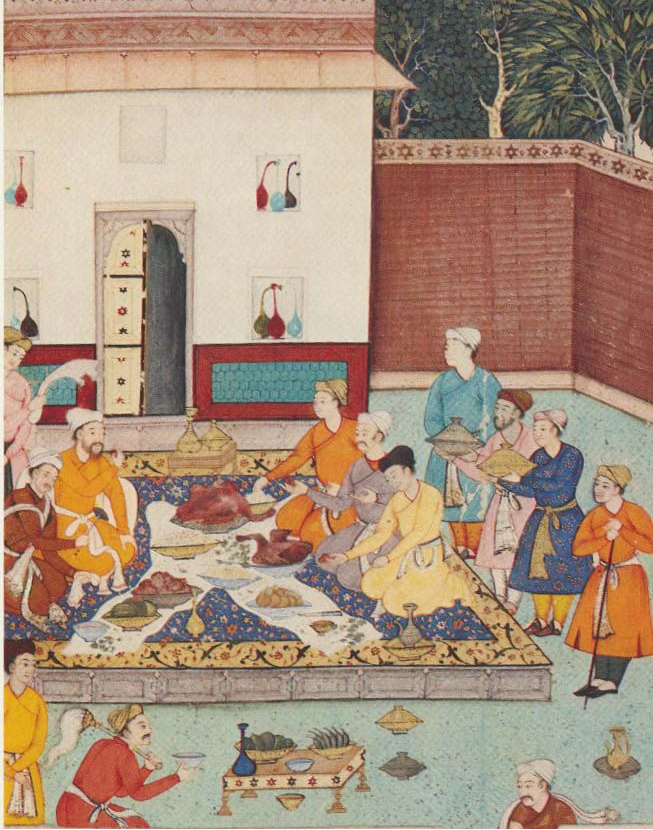
When the food was ready, the chef and Mir Bakawal, both tasted it. It was then neatly sealed in containers. Gold and silver dishes were sealed with a red cloth and those of china and copper in white. Mir Bakawal attached his seal of approval to the dishes, while a clerk made a detailed list of the vessels being carried to the royal dining room. This was a precaution against a dish being changed on the way. Even pickles, lemons and other savouries came in sealed bags. It was mandatory for the kitchen staff to roll up their sleeves and the hems of their garments and cover their mouths and noses when the food was being taken on its way to the imperial dastarkhwan, the elaborate cloth on which the dishes were kept. The covered delicacies were directly opened at the royal dining table where Mir Bakawal tasted them once again in front of the emperor. They had learnt a big lesson from the incident of Emperor Babur’s poisoning. After the meal, the dishes were taken away as per the order in which they were brought.
The Shahi Daawat
Mughal cuisine is a flavourful amalgam of Indo-Persian cooking styles and ingredients. Decorated culinary manuscripts adorned the personal libraries of the Mughal elite. Mughal food is renowned for the richness and aroma of the meals due to the use of spices, dry fruits, nuts, rich cream, milk and butter in the preparation of curry bases. The taste of this cuisine varies from extremely mild to spicy and is often associated with a distinct fragrance of whole spices. Curries and gravies were made thicker and richer with cream and yoghurts. Only five spices were used by the Mughals- cumin, onion, garam masala, saffron and coriander. Spice was added using pepper while chilli reached India with the Portuguese during Shah Jahan. A controlled quantity of spices ensured that the consumer relishes the dish in totality and not just the spices it is layered with.
The emperors had always been very fond of fruits. The newly discovered trade routes brought a wide range of fresh fruits and dry fruits to the shahi dastarkhwan. Delhi, it is said, ‘had a remarkable fruit market, with supplies from Persia, Bukhara, Samarkand and Balkh. There were three to four types of apples and pears, while black and white grapes covered in cloth were brought in wooden boxes by Afghan traders around November.’ Mango was the most cherished of all and came from Bengal, Golconda and Goa. Potatoes were brought by foreigners, probably the Dutch and British. One of the few things in India that impressed the homesick Babur was the mango. The choicest apples came from Kashmir, melons from Kabul and Badakshan, grapes from Samarkand and pineapple, which the Mughals soon began growing in Agra, from the European ports.
Like precious stones in the treasury, even fruits were graded according to their quality. Juices with flavoured essences were enjoyed. The Himalayas provided the ice for cool sherbets. Saltpetre was used to store the ice and maintain its temperature. A great connoisseurship of feasting traditions was nurtured and we have many informative records and cookbooks from the past that tell us what the imperial table looked like. Even before the Mughals, we had a comprehensive manuscript on the royal kitchen named Ni’matnama in Mandu, Madhya Pradesh. It combines Indo-Persian culinary styles and involves dishes like samosas and moong ladoos along with miniature painting depictions of food to give an even more elaborate idea.

The Ain-i-Akbari precisely divides the food of the royal kitchen into three categories: food without meat called sufiyana, food with meat and rice and food consisting of meat with spices. The sufiyana food included khichdi, badanjan, khushka made from onions, spices and fine wheat flour paste, saffron-flavoured kheer and several types of halwas, among others. The second category had haleem, kheema pulao, harissa, which was meat and cracked wheat and other meat dishes cooked with turnips, carrots, beetroots, spinach, rice and even sugar.
The third kind again was meat where we find murgh musallam, another famous dish today. It was called musamman in Akbar’s time and was a product of the Mughal-Rajput interaction. It comprised whole chicken stuffed with meat and cooked with a lot of spices and saffron. Dopiaza was also a part of this. Edward Terry, an English traveller, liked the coloured version of it that included spiced meat, onions and rice with shades of purple and green. Overall, fifty dishes sat before him on the table. About thirty types of pickles were sold in markets. Even the quantities of ingredients needed for a particular dish are mentioned and some deviating from the usual structure of Persian cookbooks, Abu’l Fazl also clarifies the serving size.
Another informative text of the Mughal period is Nushka-i-Shah Jahani but its author is unknown. It presents a whopping ten chapters on naans, zerbiryans, bhartas, porridges, khichdi, qaliyas and dopiyazas, pulaos, kebabs, desserts and pickles. We also find the recipes of yoghurts, cottage cheese and coloured butter and dough. The Mughal records also give us handy tips for cleaning fish, to get rid of the smell by rubbing it with mustard oil, chickpea flour and turmeric, soften its bones and to use a thick layer of cinnamon for slow cooking, so as to smoke a stuffed chicken. They even teach us how to cook a goose perfectly. Steaming of meat was done by keeping alternate layers of muslin cloth and grass, two of the former and one of the latter on a container with hot water. On top of those layers was kept the meat that was to be cooked. Animals like goats, ducks and fowls were fattened before slaughter.
The royal feast exhibited a myriad of colours, all obtained from natural sources. Juices of spinach, turmeric, tomatoes, beetroots, to name a few, were used to give vibrant colours like green, yellow and red, to the dish. The royal table had paneer in seven and pulao in six colours kept on it. Pulao existed even during the Delhi Sultanate period but the Mughals were greatly influenced by the Persian culture, where cooking rice is itself an art. In fact, Mughal records give us over 50 types of pulaos. There was the Navratan Pulao made with nine different vegetables. Then there was the Moti Pulao. It appeared as if pearls were kept on the dish. For this, little pieces of egg white and edible silver foil were beaten together and the mixture was placed at different spots inside the oesophagus of a chicken, after which the tube-like organ was tied into a tight knot and steamed. After some time, when the organ was squeezed, the ready mixture fell out in the form of bright pearls. There was also the Yakuti Pulao. Yakut in Persian stands for ruby. For this dish, half the rice was cooked in fresh pomegranate juice and the other half in water. These two varieties were later amalgamated which made the pulao red, thus giving it its name. Naranj Pulao which was accompanied by two shells of orange, boiled and acting as katoris, stuffed with halwa. Such a riot of colours was achieved without any usage of artificial colours!

Rich milk-based sweets gained prominence at the Mughal court and desserts like kheer, firni, almond, pistachio or carrot halwa, shahi tukda, kulfi and faluda left the diner with a sweet memory of the meal he had just had.
Turkish cooks in the Mughal kitchen were the first ones to make a mince of the meat. Spices of the Indian chefs were added to this, turned the bland old kebabs into spicy ones. Thus were born the Shami Kebab and the Seekh Kebab. There were over thirty such kebabs. Shami Kebab is a combination of minced lamb, nuts and chickpeas stuffed with chopped onions and green chillies while Nargisi kebab is a hard-boiled egg covered with a mixture of minced lamb, spices and onions which is then deep-fried. Gurak kebab had chicken filled with almonds and lamb before being finally engulfed by a flavourful coating of yoghurt and saffron.
Even something as ordinary as naan came in incredible varieties. There were about twelve different kinds of naans. Apart from the usual naan, something more wholesome was Naan Paneer [baked naan topped with cottage cheese]. There was Naan-e-Badami, Naan-e-Khurma and Naan-e-warqi. Then there was Naan-e-Besani and Naan-e-Jowar.
Alcohol had its own role too. It served a pleasure as well as medical purpose. Jahangir mentions how the women mixed liquor with rose water as a cough remedy. Wine was an independent entity and feasts focusing on food differed from those where wine assumed the central role. Juices were consumed during regular meals. Expensive wines served as gifting articles and symbols of social status among the Mughal elite. Shirazi and European wines were prevalent and liquor was distilled throughout Hindustan from various materials. Bhang was served in bazaars.
According to Francois Bernier, the Shiraz wine imported from the Persia and the Canary wine brought by the Dutch were the most expensive in the empire. The gatherings where wine was the focus also became an occasion for bonding and celebrating kinship ties. When Humayun’s rebellious brother, Kamran, came to pay homage to him, the two brothers drank wine poured from the same goblet which symbolized a reconciliation between them. Akbar sparingly took wine and firmly believed that it did not suit an emperor, who is the guardian of the realm. Jahangir’s notorious affinity for wine is not unknown and he himself admits his struggle frankly in his autobiography. It was not until his twenty-fourth birthday that Shah Jahan touched wine and that too, on his father’s insistence. He renounced it completely at twenty-nine. Aurangzeb did not touch wine and was infuriated by all the wine drinking that prevailed in his empire. Manucci tells how he sent officers after the wine vendors to cut a hand and a foot of theirs as a punishment.
Changing Times
The saga of Mughal cuisine continues. One can still find restaurants dedicated to this magnificent cuisine. Although this type of cuisine is available in all the parts of India mainly as ‘Mughlai food’, it is no longer prepared and served in its original form. As eminent food historian, Salma Hussain rightly points out, what is served today in the name of Mughlai Cuisine is only masala and oil. The actual Mughal cuisine demands a balance of the five spices and some oil. Nonetheless, if you ever happen to visit a Mughal or Nawab themed restaurant, the flavourful dishes served there will somehow make you thank a bygone empire.
Bibliography
Quotes:
Bad characters, idle talkers, unknown persons- Henry Jarrett, Ain-i-Akbari.
had a remarkable fruit market: Debasish Das, Red Fort: Remembering the Magnificent Mughals, Becomeshakespeare.com, 2019.
Primary Sources:
Bernier, François, Travels in the Moghul Empire, tr. Irvine Brock, published by William Pickering, London, 1826.
Jahangir, Nur-ud-din Muhammad, The Tuzuk-i-Jahangiri: Memoirs of Jahangir, tr. Alexander Rogers, ed. Henry Beveridge, Prabhat Prakashan, 1978.
Manucci, Niccolao, Storia do Mogor, tr. William Irvine, published by John Murray, London, 1907.
Mubarak, Abu’l Fazl ibn, The Ain-i-Akbari by Abu’l Fazl Allami, tr. From the original Persian by H. Blochmann, M.A. and Colonel H.S. Jarrett, Asiatic Society of Bengal, 1873-1907.
Secondary Sources:
Sen, Colleen Taylor, Feasts and Fasts: A History of Food in India, Reaktion Books, 2014.
Heine, Peter, The Culinary Crescent: A History of Middle Eastern Cuisine, Gingko Library,2018.
Hussain, Salma Yusuf, The Emperor’s Table: The Art of Mughal Cuisine, Lustre Press,2008.
Hussain, Salma Yusuf, The Mughal Feast: Recipes from the Kitchen of Emperor Shah Jahan, Roli Books, 2019.

Comments