_edited.png)


Domesticating Nation, Nationalizing Domestic: From Sacrality to the Figure of Abducted Body

Wendy Brown, in her piece, “Finding Man in the State”, argued while highlighting the liberal dimension of the state that in classical and contemporary liberal discourses, the familial domain has always been accorded the status of pre-political and a humane arena devoid of historicity or to be more precise, “naturally ordained”. In contrast to this, civil society is the space where rights are guaranteed by the state (“non-natural entity”) on the natural actors to maintain civility. The interesting injunction comes with the definition of the status of women in these arrangements, where they’re enframed as being “naturally” suited within the familial realm, which is tangibly observable into how the reproductive labour is considered “natural”. The labour, in turn, transpires in the domain of “privacy”, where it is interrupted continuously by men, which withers the potentiality of such space being private for women. This sphere is particularly inaccessible to laws and the conception of “personhood” in liberal discourses, can only be achieved in civil society but women are already imposed within the demarcating lines of private sphere. Therefore, men oscillate between the two realms where they exercise arbitrary power in the former and procure rights in latter. The question therein arises that how the construction of imagery or allegory of the women embodiment, which had a high political impact during the nationalist movements around the world interact and absorb such realm of privacy which inherently considered to be ahistorical.
The “political community” which are the constituents of a nation (according to Jacques Rousseau), actively practicing the distinction between the private and civil society, constructs the concept of motherland which gets abstracted from the constituent communities and they become the offsprings of said image, subordinated from the imagined entity, an essential departure from the previously claimed political consciousness. The counter proclamation was necessitated due to the authenticity of the Indianized (or more specifically, hinduized) imagery of mother goddess as against the figure of Queen Victoria. The realm of privacy is often attributive of enslaved motherhood or victimhood and the potentiality of angered/hysterical resurgence based on circumstances, which doesn’t necessarily attest the domesticity into the civil mechanism but only applicable during crisis situation, just as Bankim Chandra Chattopadhyay associated the nature of Shakta in Anandamath. The nation herein, imagined as a unified (although problematically homogeneous) kinship where the figure of such gendered allegory becomes dominant and the nation itself conceived as homely “private space”, naturally ordained and the constituents naturally tied to the space and does not hold the agency of consciously choosing its place, which precedes the question of agentic choices. Bankim’s Anandamath, talks about the phases where this transition takes place and epitomizes each phase into an allegory, the archetype of “bharatmata” became attributive of the miserability and the frail victimhood of the mother image, soon being transformed into Kali (attributive to anger and strength), showcasing a divine hysterical imagery defining a moment of departure from private domestic role at the time of crisis and shedding its femininity which doesn’t fit well with the conventional hinduized portrayal of women-hood, implying a strategic appropriation of this particular figure recreating a movement where the country desolates and procreational elements of this figure inhabits the forested or “the deserted” part of the country, that is where the figure of Kali emerges, which had tribal connections and soon to be drafted within brahminical appropriation.
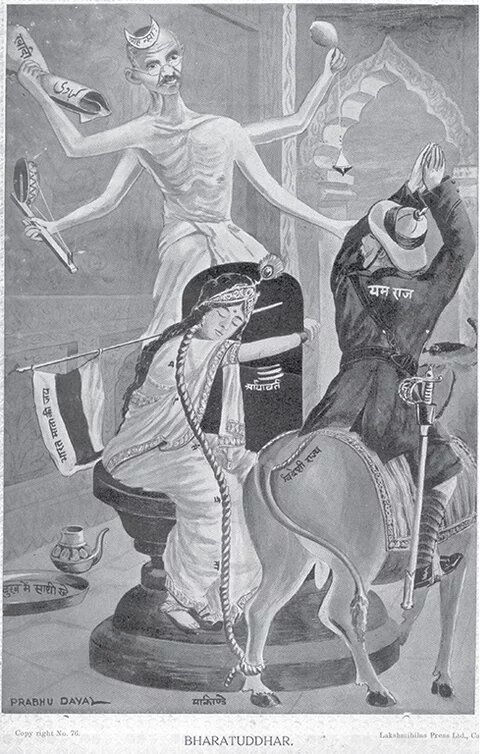
The last and conclusive figure features Mahisasuramardini, contains the characteristics of the former figures, carrying the gentle maternalizing or “innocent” motherly personality along with hysterical militancy due to the absence of organic leadership and soon to be passed down to her male offsprings. According to Sarkar, the attribution of Kali reverts back to Durga (Mahisasurmardini) and Durga becomes the domestic drudge, therefore, there’s almost or no transgression of the figurine from the private realm. Hence, the concept of rationality which is gained from the civil space or via intervention of the state, remains inherently inferior in comparison to affective and emotionally driven ‘feminised’ form of devotion, which was thought to be extremely significant for the arousal of homogeneity in nationalist interests ( construction of coherent ‘mayer jati’, meaning a race of mothers, according to Sarkar). An outright importance has been given to domesticity, as against the cosmopolitanism of the city life (in Calcutta), which Bankim’s novel implies as a “healing process” at work shedding off the antagonistic relation between the primary nurtures like mother, peasants etc and the landholders or zamindars.
The emphasize given to the countryside has an underlying intentionality towards the regenerative aspect of ordering things in its “original” place, in other words, maintaining the “purity” or sacrality in caste order or even the sanctity in the notion of “domestic women”, in contrast to the emerging cosmopolitan lives of women in Calcutta. The particular importance given to these spheres, as Spivak notes, “trichotomous ideational division on which modern political structures rest, e.g., the state, civil society, and the (bourgeois) family” brought to the subcontinent by Victorian ideals of modern “bourgeois” domesticity. According Partha Chatterjee, the society was bifurcated between two spheres, the realm of materiality and other of spirituality, the nationalist then wanted the material domain, which had a tangibility in state machinery, to be under the control of british imperial, which was also detected in Bankim’s Anandamath, where he envisioned a developmental fortune under british imperialist regime and muslim rule as the root cause for the interiorised crisis, however, the spiritual domain had to devoid of westernising impact and the nationalists were keen on maintaining the authenticity of “Indianness” by restructuring the essentialized features of how a native modern women should be and how it must be regulated within the private space.
Mrinalini Sinha rightfully states, "the re-articulation of the modern Indian woman as the agent of, and model for, an abstract nationalist Indian modernity” and the burden would lie on the shoulders of the figure or even the abstract liberal idea of a women and emerging indianized version of modern feminism in a nationalistically embroiled landscape. However, this landscape, though overwhelmed with nationalist ethos, was very mild in organising a force against imperialism, rather reworked itself rigorously in a redemptive attempt to cleanse the abstract conception gained from colonially presumed or constructed ideas by centering around the native women bodies as a contesting site. The transition of nation was extensively allegorized based on the regulation by brahminical imagination of devotion attested to the greater being but it also got percolated amongst the wider section due to its visual accessibility and availability in the public spaces.
All these fluctuations in the presentation or an imagination of the female allegory for maintaining an expression of the political community was primarily done during colonial regime. The fetishization towards the “feminized” form of nationalistic devotion towards the nation remained at its vitality even after the independence because the homogeneity gained from such “devotion” had an islamophobic intentionality and implications rather than anti-imperialist. The two domains which Chatterjee was talking about had no room for abrahamic religious elements to be accommodated within the broader definition of what could be understood as sharply “Indian”.
One of the major alteration in the mythic imagined figure of the goddess epitomizing the nation and community came during partition era. The partition in Bengal and Punjab, saw enormous inhumane incidents, where abduction of women from both sides took the centre of all attention. The honour and preservation against the female body enticed in sacrosanct domesticity finally came under direct threat and that too from the historically carved enmity with muslims. The figure of violated/abducted women became the pivot of how the masculinist space could be “purified” and regulated. As Veena Das states, “the figure of the abducted woman allowed the state to construct “order” as essentially an attribute of the masculine nation so that the counterpart of the social contract becomes the sexual contract in which women as sexual and reproductive beings are placed within the domestic, under the control of the “right” kinds of men”. The idea of social contract defined by Rousseau based on the concept of “general will”, transforms into sexual contract because of the inaccessibility of women to even come under the broad spectrum of this “will” and the state becomes a masculine space regenerating itself through an exchange of domestic sexual/ procreative labour of women with state mechanism. However, the state doesn’t present itself to be the masculinist director of such private realm, due to which the statist law doesn’t quite become compatible with women’s labour within this domain but since the state isn’t a unified whole, certain aspects of it, even if not intended, at least shapes itself to be the moral saviour of any sort of destructions faced in its functioning. The vigilante figure of the mother goddess (encompassing from domestic innocence to redemptive hysteria), which took the utmost advantage of print culture for its percolation even amongst the subaltern categories, soon replaced by the figure of abducted women who’re carrying the symbolizing significance of nationhood in transformativity, got barbarically interrupted by the musalmans. The incident got an uplifted demarcation of “national” interest, so much so that it put external (not necessarily from the families of the abducted, but an invisible force of patriarchal protectionist intentionality) compulsion of post-independence state to intervene into this domain of recovering the disturbed order in patriarchal familial relation. The Fact Finding Organization and Military Evacuation Organization were set up in order to produce a report on communal violence committed especially on women and large scale evacuation of minorities from the other side of the border respectively. According to Veena Das, the mere collective imagination of the figure of abducted women from both sides, signaled an disorder in social contract in which the state assumed the responsibility of sexual contract as, “it dismantled the orderly exchange of women”.
The intriguing fact about the evacuation process was that the “recovery” of women was entirely selective, since there was an imbalance between the state receiving reproductively active women. This desperation from the state after the entire process of Abducted Persons (Recovery and Restoration) Act of 1949, originated from the idea of proper kinship which was earlier envisioned through mythic figures from legends as ideal but faced a disorder in the domain. The idealization of an organic nation, organically pure kinship relation is not really available and state comes into being amidst this unstable situation in familial dialogues. Proper kinship means proper position of men in the family where, sexual and social contract are in contiguity. Social contract is contaminated by the later. Lastly it can be said that, the historicity in the transformation of such allegory was never taking the agency of the women in account and the law formation had never been amenable to the domain of the private.
References
Das, V. The Figure of the Abducted Woman: The Citizen as Sexed. 2006
Sarkar, T. (1987). Nationalist Iconography: Image of Women in 19th Century Bengali Literature. Economic and Political Weekly , Vol. 22, No. 47, pp. 2011-2015.
Vishwanathan, K. (2010). "Aesthetics, Nationalism, and the Image of Woman in Modern Indian Art." CLCWeb: Comparative Literature and Culture 12.2.
Brown, W. (1992). Finding the Man in the State. Feminist Studies , Spring, 1992, Vol. 18, No. 1, pp. 7-34.
Sinha, M. (2000). Refashioning Mother India: Feminism and Nationalism in Late-Colonial India. Feminist Studies, Vol. 26, No. 3, Points of Departure: India and the South Asian Diaspora (Autumn, 2000), pp. 623-644.
Chatterjee, P. (1991) "Whose Imagined Community?" Millennium: Journal of International Studies 21: 521 27.
Picture Reference
Abanindranath Tagore. Bharat Mata. 1905.
Prabhu Dayas. Bharat Uddhar. Published by Shyam Sunder Lal, Cawnpore. A proscribed image in which Gandhi saves Mother India from the depredations of colonial rule.

Comments